


About the Eighteenth-Century Ecologies Network
'In order for the Romantic period [indeed, the long eighteenth century] to teach us something about the present, it must be different from the present.' -- Jeremy Davies
Eighteenth-century and Romantic studies have long been a privileged site for the development of ecological, environmental, and green approaches to the humanities, and we believe that this spirit of innovation is still thriving in our field today. Through a seminar series hosted at the University of York's Centre for Eighteenth Century Studies, we will bring together researchers interested in all aspects of the ecological eighteenth century to hear, discuss, and build upon presentations from scholars working at the cutting edge of eighteenth-century ecological humanities.
While the study of the environment and of environmental history as a whole is indispensable for approaching the climate crisis today, we believe that the long eighteenth century’s traditionally privileged position within the ecological humanities remains justified: a period of remarkable change in all spheres of life, it represented a true turning point in the relationship between humanity and the environment.
We might point to well known material and natural changes through the century: the enclosure movement continued to condense ownership of land and intensify its agricultural exploitation, partially by intensifying control over labour. As Andreas Malm has influentially shown, this intensified control continued into the early nineteenth century and the Industrial Revolution, turning employers away from partially independent ‘flow’ energy and towards the controllable, disciplinary ‘stock’ of coal – a turn of which climate change is ‘the unintended by-product par excellence.’ At the same time, a consciousness of climate and its mutability developed in Britain and elsewhere, in response to a variety of events and ideas: in part, as the work of David Higgins and others has shown, to the drastic environmental ramifications of volcanic eruptions such as that of Tambora; partially to a newfound concern for weather, as examined by Jan Golinski and Vladimir Jankovic; in part to the emergent ‘ecology’ of adventurers and thinkers such as Alexander von Humboldt; and in part to developments in environmental medicine occasioned by increased proximity in cities and factories, brilliantly addressed by Kevis Goodman.
We might also, however, point to the cultural changes which accompanied these changes and events – the development, for instance, of new aesthetics which mediated the representation of nature: the picturesque, that great ally of the country gentry and the ‘improving’ class, and the sublime, the Romantic acknowledgement of something greater and wilder in nature. As Scott Hess and others have shown, like the carbon emissions of the Industrial Revolution, the aesthetic ideology of eighteenth-century and Romantic nature poetry has echoed through the centuries to inform much contemporary ecological thought, from the conservation movement which traces its roots to Wordsworth’s great ‘national property’ in the Lake District, to the ‘deep ecology’ of Arne Naess and others.
The latter lay at the root of the first wave of eighteenth-century and Romantic ecocriticism, in the work of Karl Kroeber, James McKusick, Kate Rigby, and particularly Jonathan Bate in The Song of the Earth (2000): a wave which sought to develop an environmental ethics of 'dwelling' based on Romantic models. In recent years, however, the eighteenth-century environmental humanities has witnessed several critical turns, including but not limited to work on the nonhuman, in the blue humanities, in new materialism, and particularly in the turn to affect, and perhaps more broadly the elemental turn. (To discover some of the most influential scholarship in these fields, check out our recommended reading page, The Commons.) These various approaches have demonstrated in their scope and power the capaciousness that ecological thinking today, in the midst of an ever-intensifying climate crisis, inspires and demands. In order to comprehend and respond to the challenges of our present, a diverse and collaborative engagement with our past is required. This is the purpose of the Eighteenth-Century Ecologies Network: we aim to bring the many important strands which have developed within eighteenth-century environmental humanities together, and to allow scholars to find echoes and sympathies within distant approaches that they may not otherwise have encountered.
The climate crisis is a vast, slow, and multifarious phenomenon, so vast that no one scholar can approach it as a whole. To understand it in its entirety requires, then, just the kind of engagement and collaboration we wish to foster here.
Convenors
The Eighteenth-Century Ecologies Network is convened by two PhD students in Romantic literature at the University of York's Centre for Eighteenth Century Studies, Kate Nankervis and Cal Sutherland. They share a strong belief in the climate crisis as the key scholarly question of our time, and between them cover a range of the many approaches to this question that have found a home in eighteenth-century and Romantic studies. This unity in difference forms the goal of the Network: to bring the diverse strands of ecological eighteenth-century studies into dialogue, and to build the field through listening, engagement, and collaboration.
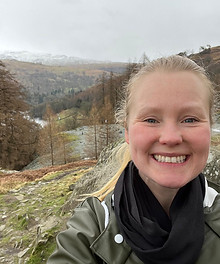
Kate Nankervis
Co-Convenor
Kate Nankervis is a PhD Researcher at the University of York. Her research focuses on clouds in Romantic-period poetry and landscape painting as a way into identifying the period’s new mode of ecological consciousness. She is the Postgraduate Representative for the British Association for Romantic Studies. Her work is supported by the AHRC through the White Rose College of Arts and Humanities.

Cal Sutherland
Co-Convenor
Cal Sutherland is a PhD Researcher at the University of York. Their work aims to develop a Marxist ecocriticism, drawing on historicist literary criticism and Marxist ecology to read literary form and syntax as cultural mediations of the changing status of land and nature within the capitalist economy of early nineteenth-century Britain. Their work is funded by a Wolfson Scholarship in the Arts and Humanities.